Livin’ for the moment . . .

Living for the moment

I’m just livin’ for the moment . . .

How many times have you heard that? How many times have you said that?

One of the definitions that I found for this phrase is as follows:

“To live or act without worrying about the future.”

So, I could say that I am living for the moment[.] – Period. Full stop.

To live in the moment, or to live in the now, means being conscious, aware and in the present with all of your senses. It means not dwelling on the past, nor being anxious or worrying about the future.

When we concentrate our attention on the present we focus on the task at hand. We give our full attention to what we are doing and we let go of outcomes.

Seizing each moment in life allows us to prolong its value and make it more meaningful. Rather than seeking quantity of time, when we live in the moment we enjoy and savor every minute. We don’t sacrifice quality for quantity.

I am fully onboard with the sentiment expressed in these thoughts. As long as we don’t overdo them with psychobabble that no one really understands. In fact, I can embrace the sentiment. Living in the moment allows me to focus on what is before me. My wife, my children, my grandchildren. The thrust of this is to put away the distractions and focus on what is present and not what has happened or may happen.


Or, I could say that I am living for the moment [. . . ] – Ellipsis. To show an unfinished thought.

Click here to read the rest of the article »

Spring Break Ideas for Dad

Spring Break Ideas for Dad

According to recent magazine article, a Swiss company will take the ashes of a dead relative and turn them into a synthetic diamond that you can wear for less than $10,000. That is a little creepy.  But that’s one way to be remembered, I suppose.

I know many of us can’t take off all week and be with our children.  But Spring Break is upon us and this is a great week to make memories with your kids that will last a lifetime.  And you can do it without the “break” in Spring Break be the breaking of the bank!  In fact, some of the ideas won’t cost you a dime!

Spring Break week ends on Friday the 13th here in Humble, TX. So, here are 13 memory-making things to do with your kids this week:

Click here to read the rest of the article »

20 Fundamental Questions for Team Building

Teamwork - Dogs

In my last post I shared 5 sports-themed principles of team building. In this post I would like to give you a practical tool to help you build a team, unify them, point them in one direction and then let them execute the plan.

One of the best leadership practices is question-asking. Accordingly I would like to give you 20 questions that you first answer yourself and then work through with your team. As you think through these questions and collaborate with your team on possible answers and implications I believe you begin will see the true potential of team-effort. There can be a beautiful synergy between team members co-laboring on mission, vision and goals but as the leader you have to ask the right questions.

The first three question are foundational questions that will lay the groundwork for building your team:

1.     Why do I want a team? — Loneliness isn’t a good enough answer; neither is “trying keep up with the times” or “trying to be relevant”. Simply claiming “best practices” or “streamlining our organization” isn’t enough either. Is a team really necessary to accomplish your task? Continue on through these questions to help you decide if you really need a team.

2.     What can a team help me do that I can’t do on my own? — Is your task big enough to need the insight and assistance of others? And are you really needing a team or do you merely need to disseminate projects? There is a difference. Simple delegation can be done without a team. True teamwork means the job can’t be done alone, and requires each person to contribute thoughts and ideas and to do their part in order to accomplish the end goal. Before we can determine if we need a team, then I guess we better discover what we are trying to accomplish.

Click here to read the rest of the article »

Ancient Observations on Leadership

Socrates

Although strategic leadership focuses on the future, it is, in fact, an ancient concept. The word “Strategy” (strategia in Greek) originally referred exclusively to leadership in a military context. Five hundred years before the birth of Jesus Christ, a “strategos” was a Greek senior, experienced, and successful military commander.  It is the equivalent of a modern-day Army general or Navy admiral.

The Greek philosopher Socrates apparently thought often about the subject of strategic leadership. He believed that just as craftsmen learn their skills, so too can ordinary people learn to become capable, even exemplary, leaders.

Xenophon, who became a strategos of great fame, was a member of Socrates’s inner circle. According to Xenophon, Socrates believed that soldiers would follow leaders who demonstrated both competency and knowledge. Xenophon wrote of what high standards Socrates had for any strategos: “He must be

Click here to read the rest of the article »

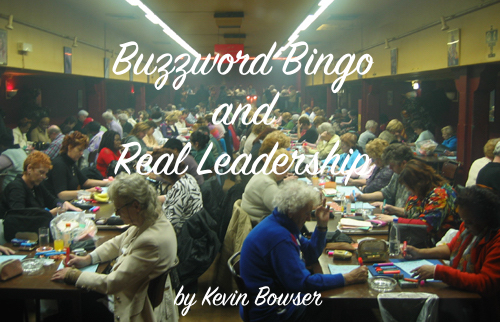
Buzzword Bingo and Real Leadership

Buzzword Bingo

How many times have you been tempted to play “Buzzword Bingo” in a business meeting?

What?  You don’t know how to play Buzzword Bingo?  Well, let me explain it quickly.

Buzzword Bingo, also known as something a little more “earthy”, is a bingo-style game where participants prepare bingo cards with certain buzzwords that they are likely to hear at a meeting or event.  They mark them off their game card when they are uttered during an event, such as a meeting or speech. The goal of the game is to mark off a predetermined number of words in a row and then yell “Bingo!” It is generally played in situations where audience members feel that the speaker, in an effort to mask a lack of actual knowledge, is relying too heavily on buzzwords rather than providing relevant details.

An important element of the game is having the courage to actually yell “Bingo!” once you have collected enough marks on your card. In order to avoid the repercussions that could result from doing that in a public setting, participants may resort to looking at one another and silently mouthing the word “Bingo”. An alternate variation requires the person who has achieved bingo to raise his or her hand and use the word “Bingo” within the context of a comment or question.

Consider if you would a couple of thoughts regarding the differences between buzzwords and real leadership.

Buzzwords are a poor substitute for the real content.  In fact, that is the key reason that some leaders tend to rely on buzzwords so much.  They really don’t have anything of real substance to offer.

Real leadership, on the other hand, offers a vocabulary of meaningful dialog.  A leader does not have to have the vocabulary of a Mensa member.  But real leaders use words of real substance and they encourage meaningful words of dialog in return.

Click here to read the rest of the article »

How Does a Leader Motivate?

Motivation

In life, it doesn’t matter where you’re coming from. What is important is this: Where are you going and how are you going to get there?

Aside from what you want to accomplish, what kind of a person do you want to become as the result of all your work and effort?  Men and women who achieve great things in life are almost always those who give thought to their own evolution and growth.  They become great people by design, not by accident.  They are like master craftsmen, continually shaping and polishing their character and personality so that they grow into someone important and worthwhile.  And so should you.

The highest goal you can have for yourself is to become a leader, to become an outstanding man or woman who is looked up to, admired, and respected by the people around you.  Motivational leadership is the ability to uplift and inspire people to perform at their best.  Personal leadership on the other hand, is the ability to motivate you to do the things, and be the kind of person that is a motivational leader.  Both are necessary, they are flip sides of the same coin.

Click here to read the rest of the article »

Pop the Question!

Pop the Question

He who asks a question remains a fool for a few minutes. He who does not ask, remains a fool forever. ~ Chinese Proverb.


I have mentioned so many times how much I love a good short quote.  And this one delivers in spades.

Think about it for a second.  What is worse than being the only person in the room who doesn’t understand something? Now imagine that weeks, months, or even years go by and you still are just not understanding the topic of discussion. But knowing that, if you ask now, everyone will wonder what you’ve been doing all this time.

Has that ever happened to you?

But what if you weren’t the only one on the team who has the same question in their mind?  What if they are all sitting around thinking that they are the only one who doesn’t “get it”?

If you have a question, but are afraid to ask, for fear of looking foolish or losing respect – relax, take a deep breath, and then go ahead ask the question.

Oh wait.  That sounded too simple didn’t it?

Click here to read the rest of the article »

Teamwork Principles from Sports

Mule Team

Teams are all the rage today in business. Surely some of this comes from our love for sports and the beauty of seeing a group of people on the field or court, working together in unity and skillfully executing a play. But furthermore we love to talk about teams today because of the camaraderie represented, the importance of each team member knowing and executing their job and the synergy that occurs through mutual trust and proficient performance. But loving the concept of “team” and actually building a team and helping it realize its potential are completely different things. I would like to propose 4 sports-themed warnings to help you build a better team.

Going 5-wide just isn’t possible; Going 4 wide isn’t sustainable – I know when you are watching Nascar the adrenaline gets pumping when the competition is tight and an inch can mean the difference between placing or even finishing. But a good crew chief will recognize how many things can actually be done effectively, simultaneously and won’t attempt more than this. When you attempt too many things at once the bottleneck will slow down progress or even worse, end up in catastrophe.

Click here to read the rest of the article »

On being a “Courager”

nomadThis is part three in a series of articles on teaching and leading your children. Part one, which introduces the series, can be found here.

I have told my kids that there are no monsters in their closets, but if there were, the reason they would be hiding in the closet is because they are scared of me. I’m guessing that although I find that a very funny idea that my kids aren’t really comforted by it. It certainly doesn’t teach them courage.

Because there aren’t any monsters in my children’s closets, I seek out other opportunities to teach courage. For example, I’m not scared of bugs because I can’t be. Someone has to kill them, and that duty falls under my job description. And if something goes bump in the night, it’s my job to get up and see what it is, and if necessary, it’s my job to deal with it. While there are teaching opportunities in each of these scenarios, overcoming a fear of bugs is probably not age-appropriate for my kids, and explaining the significance of things that go bump in the night would only give them nightmares (and would otherwise serve no purpose). Frankly, neither of these scenarios are of the sort that call upon the kind of courage that my children need at this stage in their lives.

There are other fears.

Click here to read the rest of the article »

The Business of Ethics

MM - Ethics

I am sure there has been much written about ethics in leadership but I wanted to share some insights recently revealed to me.

I had a visit with some dear friends who have been in leadership positions and one is currently writing a book on “ethics in the university”. He is a retired professor and is a dear friend so, jokingly, I asked him if he had discovered any, to which there was a resounding NO.

The chats usually go with the state of our country then circles around to business models and ethics.

First, I’m not sure why we call it “business ethics”.

Is the place we learn business ethics, in business, or is it too late then?  Our conversation had me asking that question, “Where do we learn” ethics?

Well, I got the standard business answer we all should expect and the one you are thinking. We teach them in college and have training classes and seminars. Which isn’t bad, I might add!

As you may guess at this point in the conversation, I still had plenty of questions. So, one immediate question was; at what age do we start to teach ethics?

Where and when do “we” learn ethics?

Click here to read the rest of the article »