Grooming Someone to Take Over the Team – Or Start Their Own

Grroming Someone to Take Over - 1I know that this title may be a little vague. But it has occurred to me that at some point in the life or career of a leader, there may come a time they will need to be relieved, so to speak. Now the kind of relief I am speaking of is not discontinuing your leadership, it is maybe taking a back seat in the family to a son, maybe it is grooming a son in law to take your daughter’s hand, or maybe it is a promotion in your organization or team.

As I continually struggle internally with this I realize how difficult it is for a leader to change roles. But do they really?

It seems to me even as I write this article, that we don’t stop leading, but rather we change the method or the lesson. I will get back to that in a minute. First, let’s talk about the opportunities and who we may “relinquish” our leadership too.

Click here to read the rest of the article »

Crucible of Crisis

Crucible of Crisis - 1Who likes a crisis?  Who thrives in a crisis environment? Who loves conflict and turmoil?

I know some have suggested that you should never waste a good crisis.  But that is the subject of another topic and another time.  That line of thinking may even be worthy of a “Rant” from fellow blogger, Rene Rivera.  But I would like to consider what can come from crisis and how it may impact your leadership.

It seems to me that perhaps we avoid crises to our own personal and leadership development detriment. I would submit to you that sometimes great leaders emerge and are developed in the crucible of crisis.

Does that mean that as leaders we should always seek out crisis situations?

Click here to read the rest of the article »

Rant-The Weiner Warning

rant

Anthony Weiner. His name says it all. Let me be very clear. Anthony is not a man. And he is a poor excuse for a leader. How he got elected much less married puzzles me? But men (and women) can be deceptive and present themselves better than they really are.

Anthony Weiner is a brat. He is a digital flasher. If the internet didn’t exist, he would be wearing a raincoat in a public place opening it up to any unsuspecting victim.  He is a decadent pervert. This poor excuse of a man is so intoxicated with himself and so proud of his genitals he must present them in digital format to women who are not his wife. Was that too harsh? Well maybe we as men and leaders need to call deviant behavior what it is: shameful, decadent, and dangerous.

We use soft words to describe pretty sordid behavior because it’s socially acceptable and palatable on the tongue. We call what he did sexting.  And it is socially acceptable.

For example, if I say

Click here to read the rest of the article »

Our Daughters Need Us To Comfort Them – Week 4

Needs - Week 4 - 1What would be your first words to your daughter if …

… she lost the new smartphone that you just bought for her?

… she caused a fender-bender?

… she got a ticket for texting while driving?

… she was caught skipping school to hang out with her boyfriend?

What would your first thoughts be? What would your first actual words be to her? Would they be comforting words, or words of anger and judgment?

Needs - Week 4 - 3Throughout history there is tons of anecdotal evidence to suggest that our daughters do not feel they can communicate with their fathers. They are afraid of what their father may say or do. They wonder; Will he get red-faced and blow up? Have they observed their father respond in less than positive ways when their mother puts a dent in the car while pulling into the garage?

Stay with me here. I am not suggesting that as fathers we should relax our values or our standards. And car repairs are not cheap. (That is why we have car insurance, right?) But sometimes the greater good is to be a comforting and consoling father to a daughter who is hurting – even if it is because of her own poor choices.

So, Mr. Tough Guy, how do we do that? How do we demonstrate comfort and compassion?

Click here to read the rest of the article »

God and Dr. Pepper

God and Dr. Pepper - 4

Photo credit: VeldaZ / Foter / CC BY-NC-SA

Last night at the dinner table my five- and three-year-old daughters asked me an important question:

“Daddy, may I have a drink of your drink please?”

As was the case last night as most nights, I was drinking a Dr. Pepper, and as was the case with my answer last night as most nights, I said:

“Okay, but only a sip.”

I am a fifth generation Texan. Being a Texan, a Dr. Pepper addiction, it seems to me, is my God-given birthright. And truth be told, I am addicted to the stuff. That’s not hyperbole… I really am addicted. When I lived in Seattle for a time, my friends there made dawg-fun of me for not drinking coffee, being as it is that Seattle is the Mecca to which caffeine addicts the world over pour out three cups daily. Not me. I can’t stand the stuff. Tastes like burnt – I dunno – burnt something.

Dr. Pepper? That’s different. I love my caffeine cold and sweet, hopefully over some Sonic pellet ice, and in the “Route” 44 ounce variety, please. Dr. Pepper is 23 flavors of home-grown, Waco Texas, happiness in a cup, and I love it. No, really. I *love* it.

And you know what happens to me when I don’t get my morning Dr. Pepper?

Click here to read the rest of the article »

Team Decision-Making — Part 2

Team Decision-Making - Part 2 -1The Challenge of Team Decisions

Using team input is challenging, and it takes preparation and time. As the saying goes, “If you put three people together in a room, you’ll probably get four ideas”. People often see issues differently, and they all have different experiences, values, personalities, styles, and needs. Team decision-making should therefore be used when you want to get participation and achieve agreement.

When time is of the essence, a good decision is one that’s made quickly. That doesn’t usually happen with full team decision-making. And when one or two people have the necessary expertise to make the decision, it doesn’t make sense to involve the whole team, the leaders provide most of the input and make the final choice anyway.

However, where the situation is complex, consequences are significant, commitment and buy-in are important, and where team members can work together maturely, team decision-making is often best.

Click here to read the rest of the article »

Manday-Continuing Proverbs 31 Verse 2

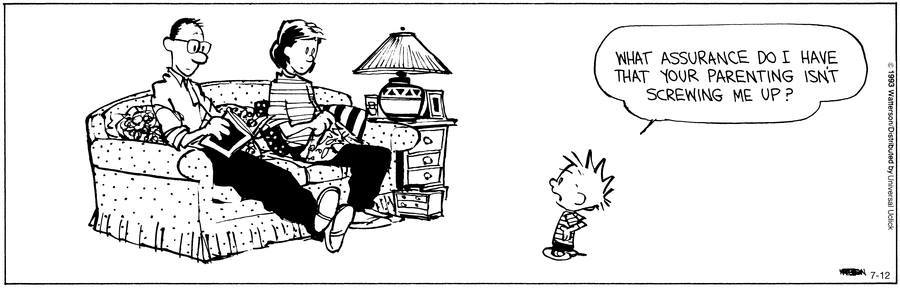
screwing

Cartoon: Watterson, Bill. “Calvin and Hobbes.” Comic Strip. facebook.com/dailycalvinhobbes 12 July 2013.

How many of you had parents?  Silly question…but I thought I would start off with that little ice breaker.

A couple of weeks ago while teaching on Proverbs, I asked the question-If you were to pass away today, what nugget of wisdom would you want your child to have learned from you?

The mother of King Lemuel asked the same question as she gave advise to her son, the King.  The second verse of the much forgotten first nine verses of Proverbs 31 reads:

What [should I say], my son?     What, son of my womb?     What, son of my vows?

Like every parent, the King’s mother speaks/writes like one concerned with what to tell him…with what to share with him.  I can feel the anguish of having to choose words carefully.  And the prose is filled with concern.

I have two years before my oldest leaves our home and embarks on his own life.  The next two years “concern” me.  I am choosing my words carefully when I instruct and correct him.  I remember presenting him to the church body when he was months old.  I vowed to raise him to love God with all his heart, soul, and mind.  I remember my vow daily.  I promised to teach my oldest to live his life for God.  Remember the name Lemuel meant “for God”.  Devoted to God.  I learned from commentaries that Solomon was also called Jedidah meaning “of the Lord”.  So what vow are we talking about?  What devotion?  The commandment from Deuteronomy 6:4-7.

4 “Hear, O Israel: The Lord our God, the Lord is one.5 You shall love the Lord your God with all your heart and with all your soul and with all your might. 6 And these words that I command you today shall be on your heart. 7 You shall teach them diligently to your children, and shall talk of them when you sit in your house, and when you walk by the way, and when you lie down, and when you rise.”

Parents teach your children what is good.  No matter their station in life, everyone needs instruction.  Kings the most.  Men the most…husbands the most…fathers the most.  Because children may recall all the good and bad teaching.

I remember thinking “Oh great…one day my kid is going to show up on Oprah and point at me and blame me for all his issues.”  Probably.

I lean toward Matt Chandler’s assessment.

“We’re just gathering all the spiritual kindling we possibly can around our kids and begging God to ignite their souls for Him”.

Phew.  Amen.


Our Sons Need to Know How to Love – Week 3

Needs - Week 3 - 1We need to cultivate an awareness and culture of love—or gentleness and kindness toward others—in our sons.  He needs you to show him how to love.

As fathers, we sometimes fail to affirm our sons. Why? Maybe we fail because it is too uncomfortable for us. Maybe we fail because we were not affirmed as young children and young men by our own fathers. It is easy to see how bad habits follow along generational lines. Maybe it is time to create some new patterns of behavior and pass them along to our sons.

We are the closest resource (for good or bad) that our sons have that will have as an example of what it is to love and demonstrate love to those around him. It is up to us to teach them that manly love is positive, gentle, giving and demonstrable in tangible ways to the objects of our love.

Good communication is one of the keys to understanding and communicating love. It is our responsibility to make communication a high priority so that we can teach our sons by example and through practice. Our sons should have heard from our lips that we love them. They should also have heard from our lips words of love and affirmation to the rest of the family. Especially, they should hear us say that to the mother of our children. They should hear us tell her that we love her on a daily basis.

But communicating love is a two-way street.

Click here to read the rest of the article »

“Thinking Gray” and “Listening Gray”

This one is going to rattle some folk’s cages. And that is OK with me. Part of the purpose of LeadershipVoices is to spur us to think in ways that we don’t always naturally think.

Thinking Gray - 1In 2001, Steven B. Sample wrote a book entitled, The Contrarian’s Guide to Leadership. I must confess I liked it just based upon the title. I mean, who doesn’t have a little “contrarian” in them? Steven Sample was the president of the State University of New York at Buffalo. And he is an accomplished leader in many ways. He was the president of the University of Southern California up until he resigned to pursue other interests in 2010.

In The Contrarian’s Guide to Leadership, Sample posits several things. He posits first of all that contrarian leaders are great leaders. While others see black and white, contrarian leaders maintain their intellectual independence and see many different shades between the extremes of stark black and stark white. He further states that contrarian leaders are those who can conceptualize a wide range of ideas, thus, making them more creative and intellectually open to solutions to the problems that plague them.

But here is the thing that challenges me about Sample’s assertions. Sample says that the leader who “thinks gray” must also learn to “listen gray”. In other words, we must learn to listen for nuance and we should avoid the fad ideas and also avoid jumping to conclusions before we have all of the input.

So what is the leadership principle here?

Click here to read the rest of the article »