Passive Leadership


Passive Leadership - 1I am currently involved in a men’s study at my church and I have been having a hard time engaging with the group. It is because, honestly, it’s boring. I had committed to a friend and Pastor that I would be involved and engaged. But the leader, as great a person as he is, is difficult to listen to. I had expressed these issues to my wife recently and she thought I needed to be more open minded about it. I was willing to give it another chance and I was sitting in there the other night and heard someone on the video say, “The biggest issue with men and their Christianity is passivity.”

I will have to admit it took me a few days for that to sink in, and what I have come up with is this. They are right. As our passivity grows, so does our acceptance of passivity. So as I thought about this over the weekend this is what came to me.

I researched “Passive Leadership” and I found the term “passive patriot”. It spoke to me. A passive patriot is a citizen who fails to combine knowledge and action to maintain democracy. The research behind this is expansive and certainly beyond the focus of this blog. However, what I couldn’t shake from my mind is the parallel to the current state of leadership in our organizations and in our country.

Passive Leadership - 2We have too many passive leaders failing to shift away from applying 20th century leadership practices to 21st century problems. Such problems cannot be solved relying on the familiar. Regardless of whether it be hierarchy, too much work, not enough time, or not enough resources, we need active leaders. The lull of passive leadership is convincing and believable.

Yet the level of inaction at the leadership level to tackle such problems is weakening organizations. In the 21st century, knowledge, and the application of it to create value for customers, is king. Underlying this reality is the acceptance that people create the profit. Without knowledgeable, enthused people, we will suffer.

Will you or your team be lulled to sleep by passive leadership and erode your value in the marketplace? Will you chase away talented employees? Will you create committed followers or customers?

We need today more leaders willing to act first and then figure out what’s next and not accept failure or misunderstanding. You can be one of them. Perhaps you already are. Many of the big problems facing businesses will simply expand in complexity the longer they are ignored or accepted.

Passive Leadership - 3You don’t need a CEO, executive, or a director to inspire you to get into action and do something to address the company’s problems. You can decide today to lead locally: lead your team to figure out what problems are limiting the value you create for your customers. And then find a solution.

Getting your hand slapped is a requirement in leadership. It’s a full contact sport. It’s standing for something bigger than you. Tackling 21st century leadership problems is worth getting your hand slapped over. It’s worth finding and using your voice.

It begins with looking at where your passive leadership is holding you back and deciding where you can turn up the volume in your leadership. Stop accepting excuses for failure. Get in the trenches with your people and lead from the front.

Photo credit: LesterSpence / Foter / CC BY
Photo credit: Max Braun / Foter / CC BY-SA
Photo credit: TechShowNetwork / Foter / CC BY-NC-ND
Photo credit: masha_k_sh / Foter / CC BY-NC-ND


Manday Movie Review(on Tuesday): Fury

fury_splash

My beautiful wife indulged me in an early Movie Date before High School Football last Friday. We saw Fury.

Wow.  Best WWII flick since Saving Private Ryan. Brutal action. Well acted.  Brad Pitt hit another home run.

Let me warn you.  This is a Manday Monday Movie Review on a Tuesday.  (For those of you new to LeadershipVoices.com – I do this thing called Manday Mondays and focus on Manhood Topics. Every once in a while, I beat my chest and post cool things that would interest and challenge men and their brave spouses.  Today is one of those days.)

If you liked Saving Private Ryan (SPR), you will like this movie.  If you liked Band of Brothers you might like this film.  I say that because Fury is graphic. The movie is spectacular and gritty. It’s SPR in a tank.  And that may be the only similarity when it comes to the blunt force trauma violence.  Saving Private Ryan  had a “decency” to its graphic nature. Fury contains almost a Tarantino-like gratuitousness. What is more troubling is the considerable amount of vicious cruelty between the protagonists. The ensemble of characters have little redeeming qualities. In other words, the good guys are not easy to pick out.  This movie is really heavy as a war movie and deserves the R rating.  I was reminded of Platoon and 300.  It’s a good flick.

My recommendation – Go see the film.  There are many leadership nuances in the film.  Enjoy the movie in the theatre. Take it in first. Let it rest on your soul.

With that said, the movie will exceed your expectations if you are looking for a film to fill that Saving Private Ryan, Band of Brothers, and The Pacific void. After speaking with several friends I am told it vividly portrays what the Greatest Generation experienced by witnessing “the cruelty men can bestow upon other men.”

“Ideals are peaceful. History is violent.” -Wardaddy.

I will see you again when Mrs. Pitts’ Unbroken and Mr. Eastwood’s American Sniper is released.


Failure is a Reality


FailingStreetSm

“There’s nothing funnier than someone else getting hurt,” I heard a comedian say.  “As long as you know they are not hurt permanently,” he continued.  “And as long as you know it hurts a lot.”  He concluded by adding: “Like when someone cracks their shin on the coffee table.”

In some ways that’s true.  On YouTube an entire channel entitled FAILARMY is devoted to showing clips of individuals failing in some task, stunt, or activity.  Usually, it comes at the expense of the individual and the cost is usually broken bones, face plants, and lots of dental work.  I can waste many hours just mindlessly watching, laughing, and grimacing at the many unfortunate souls in the videos.  I’m mostly laughing.

In society, we shun failure.  We heard it said-“Failure is not an option.”  It is usually said in some action movie or when your boss failed to plan and you are assigned the clean-up and the fire drill is on you.  I argue that failure is reality.  Failure is needed in life to set the standard for success.   Or we can just mindlessly accept participation awards and live vicariously unchallenged lives.  Failure is needed.  Failure allows us to enjoy the successes in life.

Failure is a great teaching tool.  Learning from one’s mistakes is the best pathway to future success.  As leaders, we must find ways to teach others how to succeed after failure.

I know a father whose child became so distraught because he received a 98 instead of a perfect 100 for making a capitalization error on a worksheet.  Okay.  The child failed.  The child is in second grade.  The father was alerted of this major setback through a text from his wife begging him to be easy on their child.    It was a humorous text but the underlying inexcusable error was devastating to the child.  The text served another simple but ominous request to the father to be sensitive. (NOTE-the Father complied.  He’s a good father.)

I argued that it was a teachable moment to the Father.  I explained the grade was a small failure that can easily be brushed off.  Because the error the error was made not out of ignorance or on purpose.  I advised the parent that this was a way for his child to not put so much emphasis on what others thought and understand that mistakes are very real and are a part of everyday life.

Instead, the father argued with me that he and his family strive for excellence in all that they do.  Harvard and West Point only seek the best and most excellent.  I argued that maybe the standard has shifted in recent years and that a grade of 98 if his son did everything he could to get a perfect grade was more than sufficient and adequate in the second grade and that should be celebrated.  Instead of trying to talk the boy off the ledge every time he makes a grammatical error.

With my boys-I’m okay with good grades as long as you can say to yourself you did everything you could possibly do to get that grade and that is the best you could do.  Every time my boys realize they could have done more to earn a great grade instead of settling for a good one.  Their grades are inevitably better the next time around.  (Aside-Harvard is begging for my High School Senior to visit.)

I challenged the Father to let his child fail and brush it off based on the severity of the failure.  Let the boy understand to accept short comings and not be devastated when things don’t go his way. But then I realized I failed at one major point-Never tell others how to raise their children.

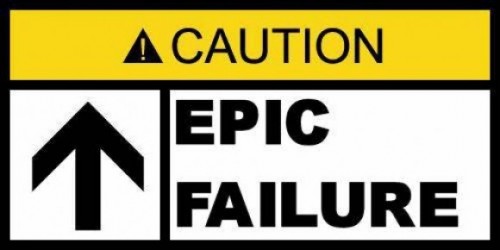
I failed.  Epic Fail.

epic-failure-e1348076197302

Legacy Leadership – Part 2 – Building a Legacy


Building a Legacy - P2 - 1Building a legacy involves many things. It involves a high degree of introspection. Legacy leaders are constantly asking themselves questions about their activities and interests. Here are just a few questions I want you to consider as we discuss building a legacy.

  • If you knew with absolute certainty that you’d die exactly 24 hours from right now, what would you do?
  • If you knew with absolute certainty that you’d die exactly 10 years from right now, what would you do?
  • Would there be any difference in your activities or the energy in which you went about them?
  • Who are the top five people that you’d want to invest your time in?
  • Do you know what you would want to pass on to them after you’re gone?

Every day, without knowing it, we are passing on to those around us who we are, what we possess and what we learn. But are we really passing along the stuff that matters for now and for eternity?

Building a Legacy - P2 - 2Most of us desire to leave an inheritance of significant value to those around us. Although we don’t always know what that means, what it includes, or how to go about it. We are bombarded in the media to plan for how to pass down our wealth. And we have some authors who are a part of Leadership Voices who can help you with those issues. But when it comes to the intangibles – the kind of stuff money can’t buy – we hear crickets from the media and from pop culture. Pop culture is concerned about the here and the now. In contrast, Legacy Leaders are concerned about those that come behind us.

We tell ourselves that we have lot’s of time. We tell ourselves that it’s OK and we will figure it out later. But the truth is, the average person will fail to pass on what matters the most to the people they care about the most.

Lord, please don’t let that be said of me.

Who comes to your mind first when you think about those you would want to pass down a lasting legacy?

Click here to read the rest of the article »

Leading Through the Doldrums


Doldrums - 1I once thought I had nothing to say about leadership, that I had nothing valuable to contribute that had not already been said by others.  That may still be true, but today I felt the need to voice some thoughts that have been rattling around in my brain.  They are probably nothing new in the conversation, but somehow I think that when common themes continue to be discussed amongst those who are on the front lines daily, who live moment by moment at the crossroads of leading or quitting, they may gain the strength to keep going one more day because they realize they aren’t alone.

You see, those who find themselves in the position of leading often find themselves feeling lonely, overwhelmed, and inadequate.  Many contemplate quitting.  Why? In many cases, it is because they have lost sight of why they are doing what they are doing.  They may have lost sight of the vision; of where they are supposed to be taking their team.  Worse yet, they may never have had a vision. In either case, without a vision, they are leading nowhere. They are simply keeping their ship afloat in the doldrums.  They get stuck managing the minutia that has no other purpose but keeping the boat from sinking.  Without vision, there is no hope of things ever being different, no sense of purpose. No hope.  No reason to keep going.

Doldrums - 2Vision casting is important.  We must help the team we lead keep focused on where they are going.  However, I have known some leaders who are so focused on the vision that they do not understand the daily needs of those they lead.  Without team building and working together with them through the daily routines and issues, the people feel abandoned. They lose respect for the leader and the team falls apart.  If a person in leadership focuses so completely on the future vision that they do not see the ominous iceberg in the water, they are leading the ship to sure destruction.

Click here to read the rest of the article »

Why Would Anyone Want To Be Led By You? Or Me?


Why Be Led By You - 1The year is nearly over. Many leaders and leadership teams are taking their annual step back to do a deep-dive assessment of their organization’s progress against the goals and objectives of their strategic plans. (What? You don’t do that at your organization?  Maybe that is part of what is holding the organization back.)

As part of your end-of-year strategic progress review, consider including another area of assessment — one that will require a different kind of evaluation and be much more introspective in nature. Why not take some time to also consider how you personally are progressing as a leader? After all, an organization’s strategic performance is, in large part, a direct reflection of the effectiveness of the person at the top.

If you want to silence a room of pastors, executives, or any group of leaders try this small trick. Ask them, “Why would anyone want to be led by you?”

Without fail the response will most likely be a sudden, stunned hush. All you will hear are knees knocking and crickets chirping.

Click here to read the rest of the article »

Leadership is… Involving


Involved - 1Leadership is involving is the third in this short series.  In case you have missed the first two, here are links to those articles.  The first one was Leadership is . . .  Modeling.  And the second one was Leadership is . . .  Teaching.  But today I want to focus on involving others through our leadership.

After we have modeled our convictions, purpose and plan and then shared with others where we are headed and how they can be a vital part of that process, then we must begin involving people.

It is not enough to plan and structure things. It is not enough to have goals and action steps, we must involve and engage people in the actual implementation. Involving begins during the previous stage of teaching/learning because it simply won’t work to tell others what the vision and plan is and how they fit in it without giving them opportunity to contribute to the formation of the vision and plan.

Involved - 2Even if you have the leverage of certain extrinsic motivators,

Click here to read the rest of the article »

Legacy Leadership – Part 1 – Focus on Legacy Leadership


Legacy - Part 1 - 6A focus on legacy leadership will drive every decision that you make and every action that you take. So, what is Legacy Leadership?

“The things which you have heard from me in the presence of many witnesses, entrust these to faithful men who will be able to teach others also.”

2 Timothy 2:2 (NIV)

 Try not to become a man of success, but a man of value. — Albert Einstein

It surprises me how many husbands and fathers don’t spend enough time thinking about their legacy – what they will leave behind for the family that they love and the people they serve. I won’t even go into how many husbands and fathers only carry the life insurance supplied by their employer. But they seem to care more about the financial legacy they will leave than the Spiritual one that will be left behind.

Legacy - Part 1 - 1But the harsh reality is that each of us is leaving a legacy whether we realize it or not or whether we want to or not.  The question is whether or not it is a legacy that is positive and has far-reaching implications into the following generations.  And for me, the legacy that I want to leave is a spiritual one.  I want to leave one that is pleasing to God.  And if it is pleasing to God, I am pretty sure I will be OK with it as well.

Webster’s dictionary defines legacy as, “anything handed down from the past, as from an ancestor or predecessor.”

Legacy is not bound by age or time served. Legacy represents your entire body of work at each stage of your life as you establish the foundational building blocks of a family and accumulate the required wisdom to contribute to the success of that family unit. Your legacy grows with each new experience, with each test or trial, and each time you inspire others to see something beyond our current circumstances.

For many, leaving a legacy is associated with the end rather than the beginning of one’s life.

Click here to read the rest of the article »

From Co-Worker to Boss


Handshake - 20141009 - 2Congratulations!  You have just been promoted to manager in your department or at your company. Or, maybe you have made the decision to start your own company and many of your co-workers have such faith in you that they are joining you in your new venture.

You are about to start one of the biggest challenges of your life. You are moving from co-worker / friend to BOSS!

You remember all those late night phone calls with co-workers, after work drinks or quick conversations during lunch or in the hall about the boss and how each of you could do a better job? They aren’t going to stop. You are just no longer invited to the conversations because the conversation is about YOU.

I have been there and done that and frankly, failed miserably. This is not about what I did right or even wrong but what I would do differently if I had to do this over again.

Conversation - 1First, accept the fact that the conversation is happening and move on. Not every decision you will make will be popular and not every decision will be right. Remember you have information that your team members don’t have and that you are not perfect. You cannot stop them from meeting after work, or at lunch. Let it go.

Use what information you already have from those sessions in which you did participate. What did your co-workers really like about the previous boss? Maybe they always appreciated the fact that birthdays and work anniversaries were special occasions. The boss may have treated everyone to something special after the completion of big projects. Lunch or chair massages or gift cards. Go beyond duplicating, expand.

Can you make changes to what wasn’t liked?

Click here to read the rest of the article »

Leaders Encourage Vigorous Debate


Vigorous Debate - 1Great leaders know how to focus on the positive, helpful, edifying and uplifting communication while managing the negative, destructive, decisive and demeaning communication in meetings.

Consider this advice from a seasoned old-timer to a young leader who was still early in his leadership career. It happens to be from the New Testament of the Bible.

“But avoid foolish controversies and genealogies and arguments and quarrels about the law, because these are unprofitable and useless. Warn a divisive person once, and then warn them a second time. After that, have nothing to do with them.” 

Titus 3:9-10

Have you ever been in a meeting that digressed and evolved into almost a free-for-all? As a contrast, have you ever been in a team meeting where the leader encouraged good debates and successfully squashed useless ones?

Such well-managed teams tend to finish their meetings with good plans and they do it on time. The participants feel productive and actually like getting together because everyone feels like they were a part of something productive.

But, back to my brief Biblical text. The Apostle Paul (the old-timer) exhorted a pastor (young leader) named Titus to refrain from arguing about peripheral subjects that divided his followers.  And I think that advice is relevant to leadership principles today.

There is a branch of modern communication theory that seems to have grown out of the apostle Paul’s philosophy. In 1968, Sir Charles Geoffrey Vickers, an English lawyer, administrator, writer, and pioneering systems scientist introduced the concept of “appreciative systems”, which later became Appreciative Inquiry (AI). It was really further developed nearly 20 years later at Case Western Reserve University’s department of Organizational Behavior. It started there with an article in 1987 by David Cooperrider and Suresh Srivastva. They felt that the overuse of “problem solving” as a model often held back analysis and understanding, focusing on problems and limiting discussion of new organizational models. At its core, AI is positive debate that explores what an organization does well and how it can build on its strengths.

Vigorous Debate - 3As leaders it’s sometimes difficult to limit discussion and keep debates from getting out of control.

Click here to read the rest of the article »